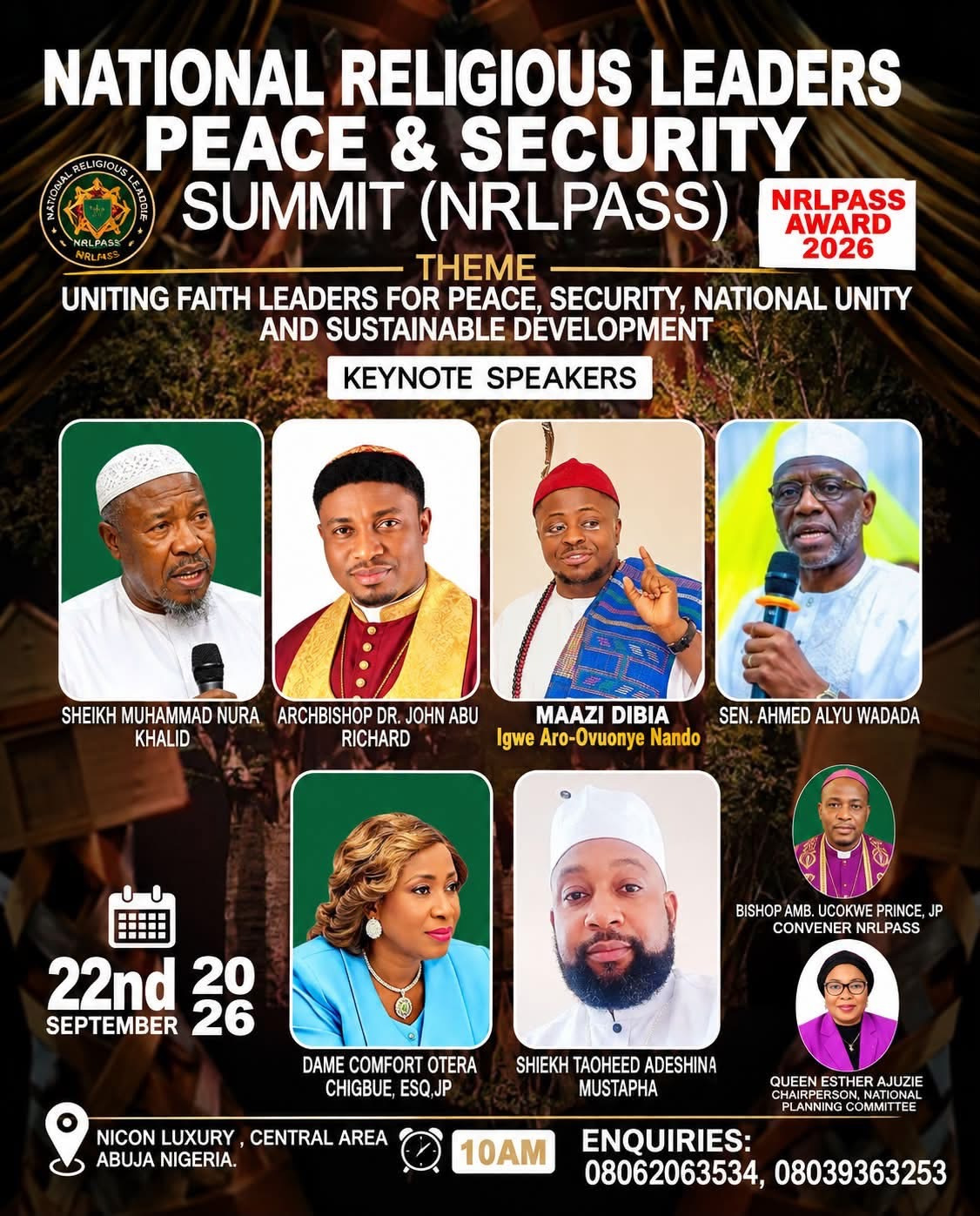
Written by:
HSM Igwe Aro-Ovuonye Nando, MAAZI DIBIA
(UCHECHUKWU OBIAJULU SAKAR)
KEYNOTE ADDRESS
PEACE, SECURITY & CREDIBLE ELECTIONS:
THE ROLE OF FAITH LEADERS TOWARDS & BEYOND 2027
Theme: Strengthening collaboration among religious leaders, security agencies, traditional institutions and citizens to prevent violence, protect communities and promote peaceful participation before, during and after the 2027 elections.
Distinguished Chairperson,
Our revered traditional rulers and traditional institution leaders,
Distinguished religious leaders and representatives of various faith communities,
Our security agencies and members of the security community,
Representatives of government and electoral institutions,
Civil society leaders,
Community leaders,
Women and youth leaders,
Members of the media,
Ladies and gentlemen,
I am deeply honoured to stand before you today to speak on an issue that is not only important to our democracy but fundamental to our survival as a people.
The subject before us is peace, security and credible elections.
But I want to begin by saying something very simple:
Elections are not supposed to be a war.
An election is supposed to be a peaceful process through which citizens decide who should represent them and how they want their society to be governed.
We may disagree. We may belong to different political parties. We may support different candidates. We may worship differently. We may come from different ethnic groups, communities, regions and social backgrounds.
But at the end of the day, we must remember one fundamental truth:
Before we are members of political parties, we are citizens. Before we are supporters of candidates, we are human beings. And before we are Christians, Muslims, practitioners of indigenous traditions or members of any other faith community, we are Nigerians.
That is why today's conversation is bigger than the 2027 elections. It is about the kind of country we want to leave behind for our children.
THE ELECTION IS NOT MORE IMPORTANT THAN THE PEOPLE
As we approach the 2027 General Elections, Nigeria is entering another important period in our democratic journey. INEC has formally released the timetable for the 2027 elections, with the Presidential and National Assembly elections scheduled for 20 February 2027, and the Governorship and State Houses of Assembly elections scheduled for 6 March 2027.
That means 2027 is no longer a distant conversation. Preparation has already begun. Political parties, candidates, citizens, institutions and security agencies are preparing. Importantly, religious and traditional institutions must also prepare.
But prepare for what? Not merely for election day. We must prepare for the entire electoral cycle: before the election, during the election, immediately after the election, and even beyond the election.
The greatest danger to peace does not always occur on election day. Sometimes the crisis begins months before the ballot is cast—with inflammatory speeches, rumours, ethnic mobilisation, religious manipulation, misinformation, and political disagreement turning into personal hatred. Sometimes it begins in places where we least expect it: in our places of worship.
THE MORAL RESPONSIBILITY OF FAITH LEADERS
Faith leaders possess something that political institutions cannot easily manufacture: trust. People listen to their pastors, imams, traditional spiritual leaders, priests, bishops, reverends, evangelists and other religious authorities—in moments of joy, grief and confusion.
But with influence comes responsibility. The pulpit must never become a political battlefield. The mosque must not become a centre for hatred. The church must not become a place where opponents are demonised. Our traditional institutions must not become instruments for political intimidation. Our religious and cultural identities should never be weaponised against our fellow citizens.
I therefore appeal to our religious leaders: Preach peace before there is a crisis. Do not wait until people are burning houses or being killed before we tell our followers that violence is wrong. Peace must be preached before the crisis.
WE MUST SEPARATE POLITICS FROM VIOLENCE
There is nothing wrong with political competition, campaigning or disagreement. The problem begins when disagreement becomes hatred, and hatred becomes violence.
We must teach our people that losing an election does not make someone an enemy of the state. Winning an election does not give someone permission to humiliate those who lost. Democracy requires both winners and losers to respect the rules. Those who win must govern with humility; those who lose must have lawful avenues to challenge the process.
INEC has called on political parties, candidates, supporters and voters to conduct themselves peacefully throughout the electoral cycle, emphasizing that the success of the 2027 elections is a collective responsibility. That collective responsibility includes all of us.
SECURITY IS NOT ONLY THE JOB OF SECURITY AGENCIES
Security agencies have an important constitutional and professional responsibility to prevent violence, protect election officials and materials, and ensure that polling, counting and collation take place without disturbance. At the same time, security personnel must not interfere with the conduct of the poll, counting or collation.
But security cannot be achieved by security agencies alone. A police officer cannot be present in every village. A soldier cannot stand beside every citizen. A security agency cannot monitor every WhatsApp group or hear every conversation in every home, market, religious gathering or community meeting.
But our religious leaders can. Our traditional rulers can. Our community leaders can. Our youth leaders can. Our women leaders can. Our citizens can. That is why we need a community-based security architecture in which citizens become partners in prevention rather than merely observers of crisis.
FROM REACTIVE SECURITY TO PREVENTIVE PEACEBUILDING
One of the biggest mistakes we make is responding to crises only after they have started. Someone is killed, a community is attacked, a religious conflict erupts or a polling station is disrupted—and then we react. The question we should ask is: Could we have prevented it?
Faith leaders and traditional leaders are often among the first people to know when tension is developing. They hear rumours, complaints and dangerous rhetoric. We therefore need mechanisms through which concerns can be responsibly communicated to appropriate authorities before they become violence.
Early warning must not become an excuse for profiling or persecution. We must verify information, protect innocent people, avoid spreading rumours, respect human rights and ensure that security responses are professional, lawful and proportionate.
RELIGIOUS LEADERS MUST BECOME BRIDGES, NOT BARRIERS
Nigeria's religious diversity should not be our weakness; it can be our strength. Christian leaders should sit with Muslim leaders. Muslim leaders should sit with Christian leaders. Traditional religious leaders should sit with both. All of us should sit with security institutions, government representatives, civil society organisations and ordinary citizens.
We must create permanent platforms for dialogue, rather than emergency meetings after violence has already occurred. In every local government area, regular meetings could bring together religious leaders, traditional rulers, security representatives, INEC representatives, youth and women representatives, community leaders, civil society organisations, political party representatives and the media. They could identify emerging tensions, counter misinformation, promote voter education, develop community peace agreements and resolve disputes before they become violent.
THE ROLE OF TRADITIONAL INSTITUTIONS
Traditional rulers possess legitimacy rooted in history, culture and community identity. Their influence should be used to protect communities. They can work with religious leaders and security agencies to identify vulnerable communities, discourage reprisals and promote dialogue.
After politicians finish campaigning, ordinary people remain neighbours. Their children attend the same schools, they share markets and depend on one another for survival. Let us never allow politicians to turn neighbours into enemies.
THE YOUTH: FROM TARGETS OF POLITICAL VIOLENCE TO AGENTS OF PEACE
Young people are often mobilised for political confrontation, yet they are among the first to suffer the consequences. Your future is worth more than anybody's political ambition. Do not allow anyone to use your anger as a weapon. Use your energy for voter education, responsible social media, challenging misinformation, peaceful participation and civic engagement. Participate and vote—but do not kill for anybody.
THE DANGER OF MISINFORMATION AND HATE SPEECH
A rumour can reach thousands within minutes. A manipulated video can create panic. An old photograph can be presented as a recent incident. A fabricated story can be circulated as breaking news. Faith leaders must become champions of truth.
Before forwarding a message, verify it. Before announcing an alleged attack, verify it. Before accusing another community, verify it. And when something is not verified, have the courage to say: “We do not know yet.” That sentence can save lives.
CREDIBLE ELECTIONS REQUIRE TRUST
A credible election begins with citizens believing that the process is worth participating in. It requires confidence that voters can cast their ballots without intimidation, political actors to respect the rules, electoral officials to perform professionally, security personnel to maintain order while respecting the process, observers and media to operate responsibly, and citizens to accept lawful disagreement.
Credibility is a collective project. The ballot belongs to the citizen—not to a party, candidate, religious leader, traditional ruler or security officer. Every citizen should be free to vote according to conscience without intimidation, discrimination or threat.
FAITH LEADERS SHOULD NOT BE NEUTRAL ABOUT VIOLENCE
Faith leaders may have different political preferences, but there must be absolute moral clarity: We cannot be neutral about violence. Violence is wrong whether committed by supporters of our preferred candidate or supporters of the candidate we oppose. If hate speech is dangerous, it is dangerous regardless of whose political interest it serves. Our moral standard must be consistent.
WHAT SHOULD WE DO BEFORE 2027?
- Establish interfaith peace committees at community level.
- Establish direct communication channels with security agencies.
- Develop community peace agreements and public commitments to non-violence.
- Conduct voter education on rights, responsibilities and lawful remedies.
- Counter misinformation by verifying suspicious information.
- Protect women, persons with disabilities, minorities and vulnerable citizens.
- Engage young people in peacebuilding, civic education and decision-making.
- Create rapid-response dialogue mechanisms.
- Encourage peaceful dispute resolution through lawful institutions.
- Continue the work after the election. Peacebuilding must not end when the results are announced.
WHAT HAPPENS AFTER THE ELECTION?
Election day is not the finish line. After results are announced there may be disappointment, celebration, allegations, court cases, protests and political tensions. Faith leaders must again become bridges. If your candidate loses, encourage peace. If your candidate wins, encourage humility. If there are disputes, encourage lawful resolution.
Democracy is bigger than one election. Nigeria, our communities, families, businesses, religious institutions and traditional institutions will continue after 2027. Whatever happens politically, we must still find a way to live together.
BEYOND 2027: THE NIGERIA WE WANT
Our objective cannot simply be one peaceful election. We need a culture where peaceful elections become normal; where political opponents disagree without becoming enemies; where religion builds bridges; where traditional institutions partner in peacebuilding; where security is understood as a partnership; where young people see politics as service rather than violence; where women participate freely; and where citizens trust peaceful, lawful avenues for grievances.
A MESSAGE TO POLITICAL ACTORS
Please do not weaponise our differences. Do not use religion to create enemies, ethnicity to mobilise hatred, or young people for violence. Do not spread information you know to be false. Politics should be about service, ideas, policies and competing visions—not fear.
A MESSAGE TO SECURITY AGENCIES
Citizens need you, but they also need to trust you. Professionalism, impartiality, restraint and respect for the law are essential. Protect voters, electoral officials, electoral materials and communities, while remaining within the boundaries of your lawful responsibilities. The security of Nigeria cannot be separated from the trust of Nigerians.
A MESSAGE TO ORDINARY CITIZENS
You have power. Your vote is power. Your voice is power. Your decision not to participate in violence is power. Your refusal to spread a false message is power. Your decision to protect your neighbour is power. Peace is created in homes, churches, mosques, traditional institutions, markets, schools and communities by ordinary people making extraordinary decisions not to destroy one another.
THE COVENANT WE SHOULD MAKE TODAY
We will not use religion to promote violence.
We will not use ethnicity to promote hatred.
We will not use politics to destroy our communities.
We will not allow misinformation to become a weapon against our neighbours.
We will not recruit our young people into violence.
We will speak when we see danger.
We will intervene before conflict becomes violence.
We will work with security agencies responsibly.
We will respect the role of traditional institutions.
We will defend every citizen's right to participate peacefully.
We will accept political differences without turning them into personal hatred.
No political office is worth the blood of a Nigerian.
CONCLUSION: OUR FAITH MUST PRODUCE PEACE
Our various religions teach different traditions and doctrines, but one message is universal: Human life has value. Peace has value. Truth has value. Justice has value. Human dignity has value.
The real test of religious leadership is what happens when communities are angry. Can we calm them? When people are divided, can we bring them together? When rumours spread, can we insist on truth? When young people are recruited for violence, can we persuade them to walk away? When our own supporters are wrong, can we tell them they are wrong?
That is leadership.
FINAL CHARGE
As we journey towards 2027, let us not wait for violence before we become peacebuilders. Let us create the networks, relationships and communication channels now. Let us engage young people, political actors, security agencies and traditional institutions now. Trust must be built before it is needed. And peace must be built before it is tested.
Nigeria belongs to all of us. No political party, religion, ethnic group or individual owns Nigeria. Nigeria belongs to its citizens.
Let our churches preach peace. Let our mosques preach peace. Let our traditional institutions defend community harmony. Let our security agencies protect citizens professionally and lawfully. Let our political leaders compete with responsibility. Let our young people choose their future over political violence. Let women participate fully and safely. Let our citizens choose dialogue over destruction.
An election can determine who occupies an office. But only peace can determine whether the people survive to enjoy the country that election is supposed to serve.
Therefore, as we move towards 2027 and beyond: Let us choose peace. Let us protect our communities. Let us defend democratic participation. Let us respect our differences. Let us reject political violence. Let us uphold truth. Let us work together.
Because at the end of every election, there must still be a Nigeria left for all of us.
May our elections be peaceful. May our institutions be strengthened. May our communities be protected. May our leaders act with wisdom. And may Nigeria emerge from every electoral season more united, more democratic and more peaceful than before.
Thank you, and may God Almighty bless you all.
May God bless the Federal Republic of Nigeria.
“MAY WE NOT LOOSE OURSELVES IN SEARCH OF OURSELVES.”


AI Before AI
Exploring Ancestral Intelligence and the future of African knowledge in an age of machines.


Visited Countries
A globe trotter journey across Africa, Asia, the Middle East and beyond.
Malaysia
Rwanda
South Africa
Uganda
Ethiopia
Eswatini
Burkina Faso
Morocco
Ghana
Benin
Togo
Turkey
Angola
Russia
Qatar
China
India
Cameroon
Dubai
Japan
Cambodia
Vietnam
Thailand
Egypt
Israel
Türkiye
“May we not lose ourselves in search of ourselves.”
JOIN THE JOURNEY
Receive new writings, teachings, book announcements, events and cultural reflections from Maazi Dibia.
